Colorado Sexual Assault Statute of Limitations: How Timing Affects Prosecution
October 19, 2026


What Happens at a Denver Preliminary Hearing After Felony Arrest
Can Dash Cam Evidence Be Used to Challenge DUI Charges in Colorado?
Only one drug felony level in Colorado carries a true mandatory prison sentence. The other three carry presumptive ranges where a judge still has discretion, meaning the defense strategy in a DF2, DF3, or DF4 case looks completely different from that in a DF1 case. At the Law Office of Jacob Martinez, our Denver drug crimes attorney has spent more than a decade in Denver courts, working to achieve better outcomes for clients facing felony drug charges.
Colorado divides drug felonies into four levels. The highest level, Level 1, is the only drug felony for which the court is required to impose a mandatory prison sentence regardless of mitigating circumstances. The mandatory floor starts at 8 years and can reach 32 years.
Levels 2, 3, and 4 are different. They carry presumptive sentencing ranges, meaning the judge has discretion within a set window. A skilled defense can still argue for probation, a suspended sentence, or a sentence below the presumptive range at these levels. The difference between DF1 and DF2 is not just a number. It is the difference between a floor the judge cannot move and a range where your attorney can still fight.
Colorado’s four felony tiers apply to drug possession and distribution charges across the full spectrum of controlled substances, and the charged level, not the substance type, drives sentencing exposure.
Even if you are charged with a DF2, DF3, or DF4, prosecutors can seek a special offender designation that elevates sentencing exposure to Level 1 territory. This is not a separate charge. It is a sentencing enhancer, and it is one of the more consequential tools prosecutors use in Colorado drug cases.
The designation typically applies when the alleged offense involved a weapon, occurred within a drug-free zone such as a school, or used a minor in the distribution chain. Being near a school during a transaction, even without knowledge of the proximity, has been used to support the designation.
The practical effect: a DF3 drug charge with a presumptive range where probation is a realistic option can turn into a case with a mandatory prison floor. Defense begins with a close review of aggravated drug sentencing triggers, specifically whether the government’s facts actually support the designation.
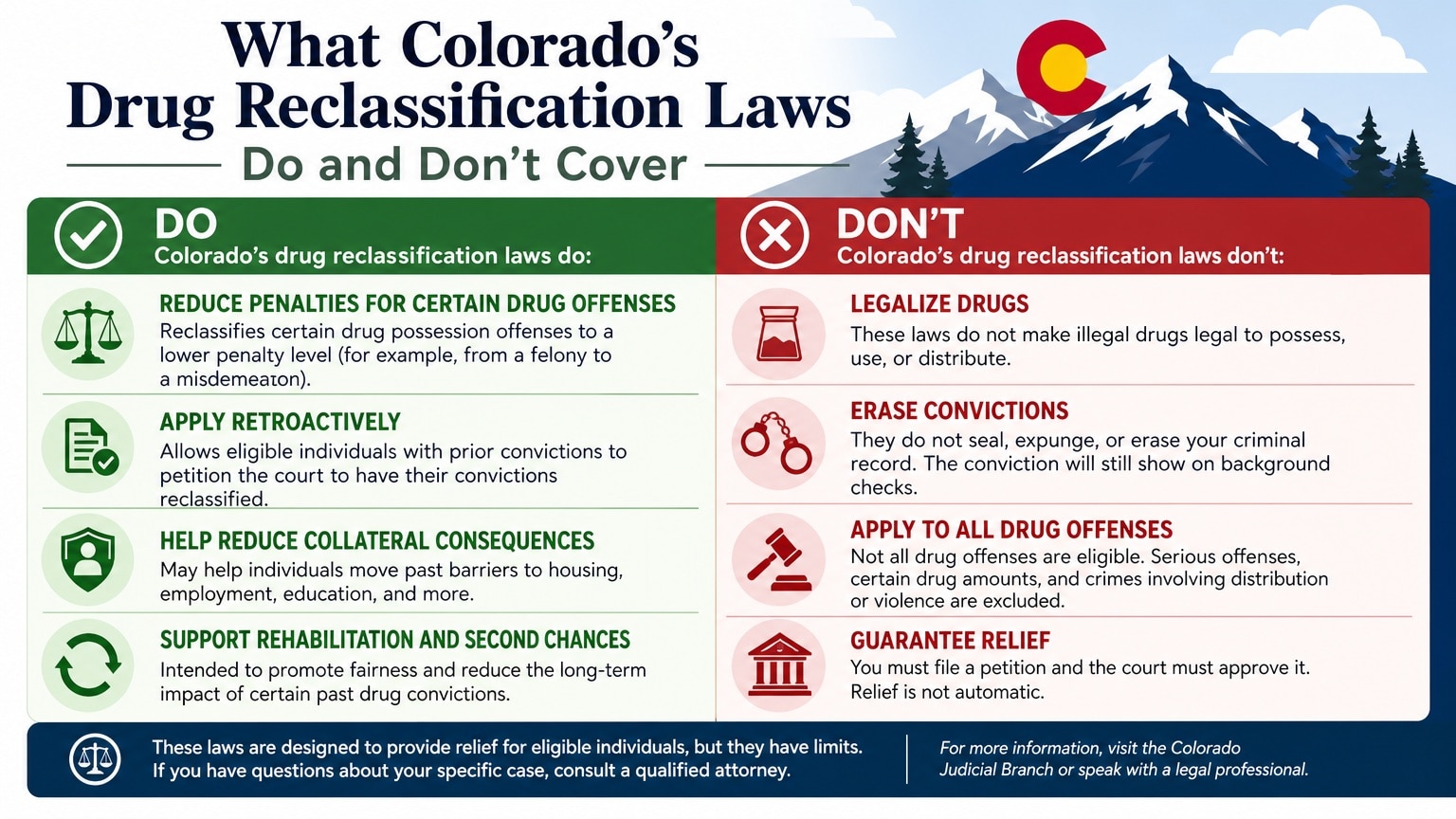
Before 2019, possessing even small amounts of many controlled substances was a drug felony in Colorado. The state’s drug reform legislation changed that, reclassifying possession of 4 grams or less of most Schedule I and II substances from a felony to a misdemeanor.
Colorado’s current drug sentencing framework is shaped by the 2019 reclassification law and the 2020 partial rollback that followed, which together determine what counts as a felony and what qualifies for misdemeanor treatment.
What those reforms did not change: distribution, manufacturing, and felony-weight offenses remain drug felonies. Repeat convictions can still trigger escalating felony tiers. A charge that starts as misdemeanor possession can quickly become a felony if the government alleges distribution intent based on quantity, packaging, or paraphernalia.
For DF2, DF3, and DF4 cases, prison is not guaranteed. Colorado courts have programs specifically designed to resolve drug felony cases without incarceration:
These options do not exist at DF1 or for defendants carrying the special offender designation. That is the line that matters. A Colorado drug felony defense lawyer who understands how Denver District Court evaluates treatment history, compliance history, and individual circumstances can build a case that keeps these options alive.
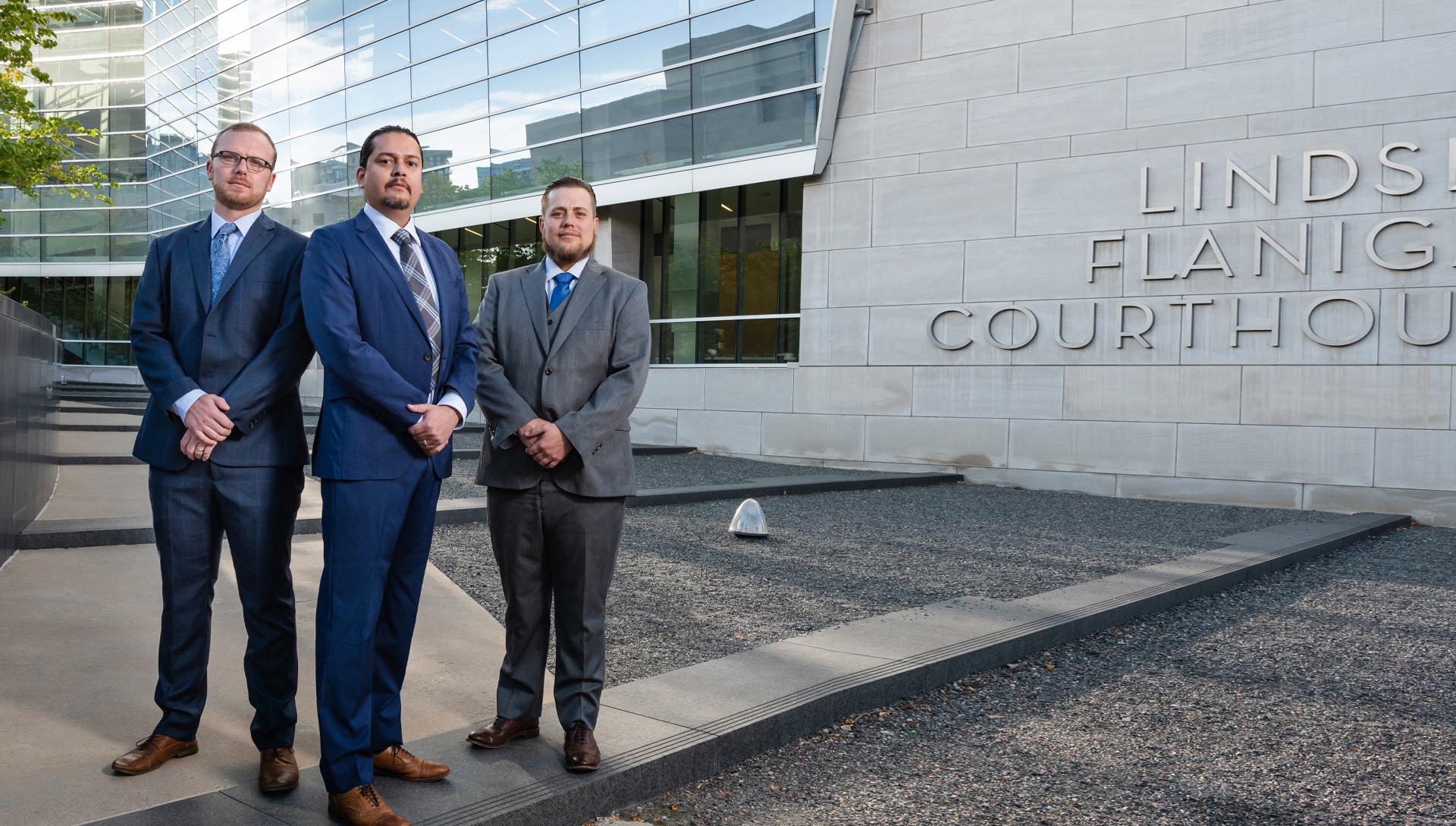
Facing a drug felony charge in Colorado can feel overwhelming, but you do not have to navigate the complex legal system alone. At the Law Office of Jacob Martinez, we provide aggressive, community-rooted criminal defense to protect your freedom and future. Whether your case involves a complex DF1 charge or navigating alternative sentencing in Denver District Court, our award-winning legal team is ready to build a strategic defense tailored to your situation. Contact us online or call 720-246-6700 to schedule your free, confidential case consultation today.