When Denver Police Use Confidential Informants: How the Defense Challenges Reliability
September 12, 2026


A confidential informant almost never speaks to the judge who signs the warrant. Instead, the judge reads a detective’s sworn summary of what an unnamed person allegedly said. That gap can become one of the most important issues in a Denver drug, weapons, theft, or other criminal case.
The defense does not cross-examine the informant when the warrant is issued. At that stage, the focus is on the affidavit itself: what the informant allegedly knew, how police verified the information, [...]
Most criminal cases in Denver do not end with a jury verdict. They end with a decision: whether to accept a plea agreement, reject the offer, keep negotiating, or prepare for trial. That decision can shape your record, your freedom, your sentence, your probation terms, and your future long after the court date.
A plea bargain is not just “taking a deal.” It is a legal agreement that may involve reduced charges, dismissed counts, sentencing limits, probation terms, restitution, treatment [...]
Eyewitness testimony is undeniably a powerful form of evidence in criminal cases. However, there have been studies showing it is also one of the leading causes of wrongful convictions in Denver and across the United States. This suggests that human memory is not perfect and that some situations can lead to errors in identification.
In Denver, cases involving eyewitness misidentification span a wide range of crimes. You must defend against wrongful convictions, which requires a detailed review of the circumstances [...]
Mental health conditions can intersect with criminal justice in complex ways, requiring nuanced handling. In Denver, urban stressors can exacerbate these challenges, making it essential to understand how mental health affects criminal cases.
Consulting a Denver criminal defense lawyer at the Law Office of Jacob Martinez early ensures these factors are addressed properly, potentially leading to treatment-focused resolutions instead of punitive measures.
How Mental Health Influences Criminal BehaviorMental health disorders can shape behavior in ways that lead to criminal [...]
A confession is one of the most powerful pieces of evidence in any criminal case. Denver law enforcement officers are trained to use strategic questioning and behavioral tactics to elicit statements. While many interrogations follow lawful standards, some cross the line into coercion. Once a confession is recorded, prosecutors may rely heavily on it, regardless of whether the statement was obtained fairly or accurately reflects the truth.
At the Law Office of Jacob Martinez, our criminal defense team understands how [...]
A confidential informant almost never speaks to the judge who signs the warrant. Instead, the judge reads a detective’s sworn summary of what an unnamed person allegedly said. That gap can become one of the most important issues in a Denver drug, weapons, theft, or other criminal case.
The defense does not cross-examine the informant when the warrant is issued. At that stage, the focus is on the affidavit itself: what the informant allegedly knew, how police verified the information, [...]
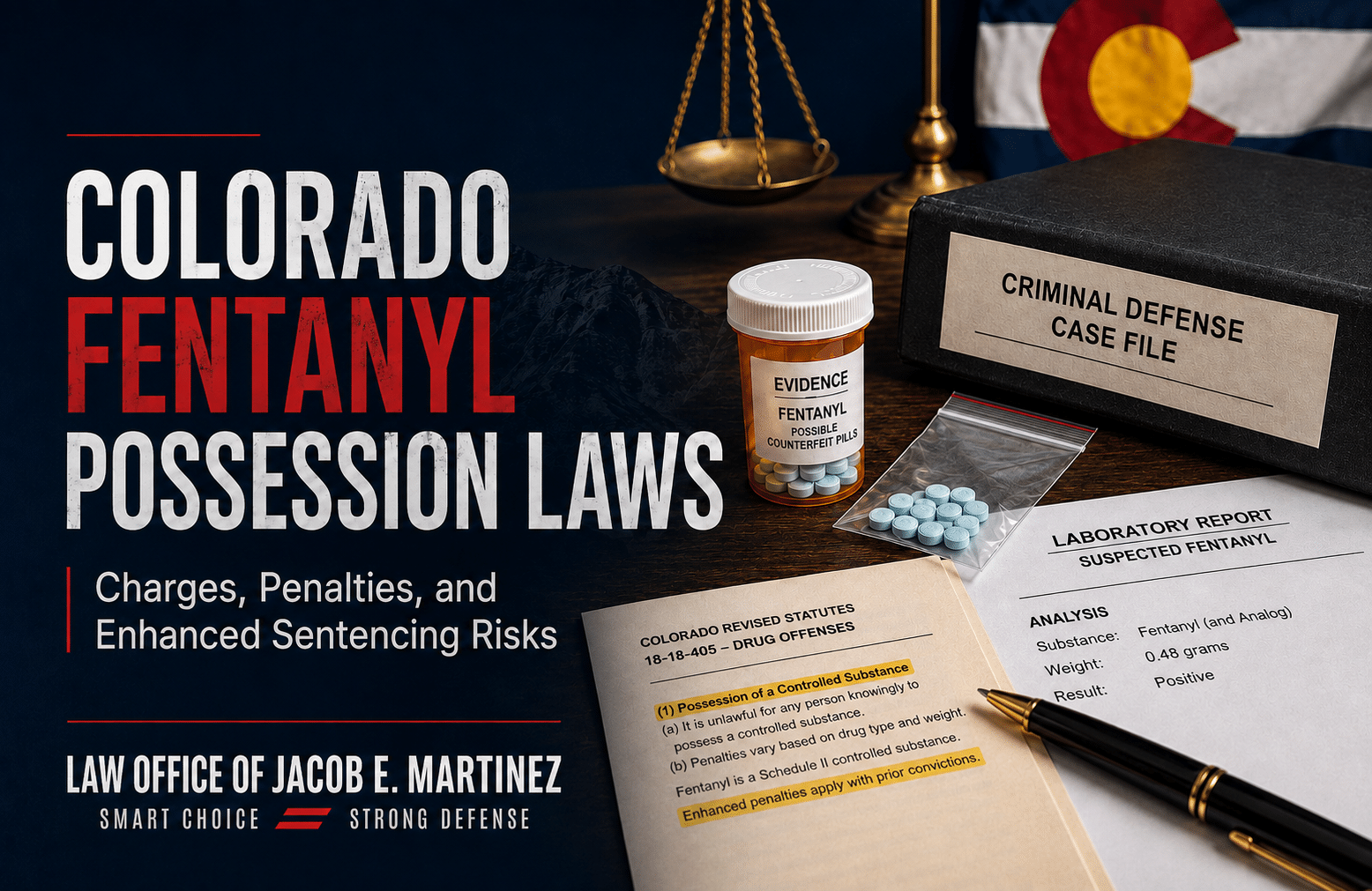
Colorado fentanyl possession charges can become serious felonies at relatively low weight thresholds. The law focuses on the weight of the material, compound, mixture, or preparation containing fentanyl rather than only the amount of pure fentanyl inside it. That means a small-looking quantity of powder or counterfeit pills can result in a much more serious charge once the substance is tested and weighed.
Weight is only part of the case. What the accused person knew, whether the state can prove [...]
Colorado COCCA charges are racketeering charges used when prosecutors claim a person participated in an enterprise through a pattern of criminal activity. These cases often grow out of drug, theft, burglary, fraud, identity theft, or financial investigations that are later reframed as organized conduct.
A COCCA count is not automatic just because several people were charged together or because prosecutors believe more than one crime occurred. The state must prove specific structural elements, including an enterprise and a pattern of [...]