When Denver Police Use Confidential Informants: How the Defense Challenges Reliability
September 12, 2026


Self-defense is one of the most frequently raised arguments in Colorado criminal cases involving assault, homicide, or weapons charges. When a person believes their safety is threatened, the law allows them to use reasonable force to protect themselves. However, the scope of that right depends on the circumstances. While some states have explicit “stand your ground” statutes, Colorado takes a different approach, blending principles of the Castle Doctrine, the state’s “Make My Day” law, and court rulings that have shaped [...]
If you’re facing assault charges but only acted to defend yourself, it can feel confusing and unfair. Proving self-defense isn’t always easy because the law looks closely at whether your response was reasonable.
At the Law Office of Jacob Martinez, our experienced Denver, CO assault defense lawyers have helped over a thousand people in situations just like yours. You tried to protect yourself—or someone else—and now you’re caught in a legal system that doesn’t always see the full picture.
We’re [...]
Domestic violence is a serious offense in Colorado, and the laws clearly outline what the justice system considers domestic violence.
While the definition of domestic violence may be clear in the state, the idea that someone was defending themselves against the abuse of another isn’t as clear. It’s common in domestic violence cases for the party being accused of domestic violence to say they were only acting in self-defense. However, anyone claiming self-defense can only argue it successfully in court [...]
A confidential informant almost never speaks to the judge who signs the warrant. Instead, the judge reads a detective’s sworn summary of what an unnamed person allegedly said. That gap can become one of the most important issues in a Denver drug, weapons, theft, or other criminal case.
The defense does not cross-examine the informant when the warrant is issued. At that stage, the focus is on the affidavit itself: what the informant allegedly knew, how police verified the information, [...]
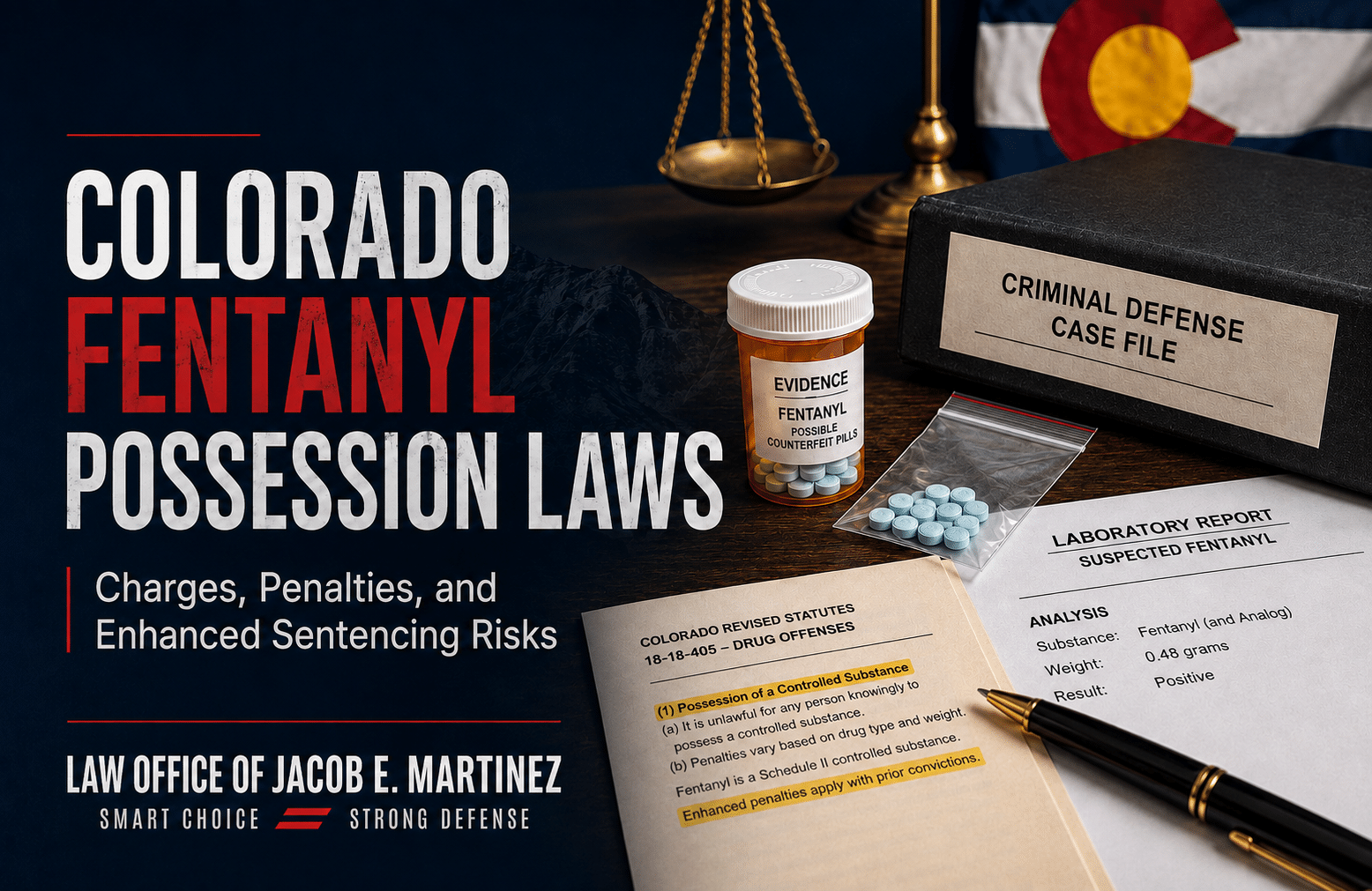
Colorado fentanyl possession charges can become serious felonies at relatively low weight thresholds. The law focuses on the weight of the material, compound, mixture, or preparation containing fentanyl rather than only the amount of pure fentanyl inside it. That means a small-looking quantity of powder or counterfeit pills can result in a much more serious charge once the substance is tested and weighed.
Weight is only part of the case. What the accused person knew, whether the state can prove [...]
Colorado COCCA charges are racketeering charges used when prosecutors claim a person participated in an enterprise through a pattern of criminal activity. These cases often grow out of drug, theft, burglary, fraud, identity theft, or financial investigations that are later reframed as organized conduct.
A COCCA count is not automatic just because several people were charged together or because prosecutors believe more than one crime occurred. The state must prove specific structural elements, including an enterprise and a pattern of [...]