When Denver Police Use Confidential Informants: How the Defense Challenges Reliability
September 12, 2026


In Arapahoe County, a client of Mr. Martinez’s was charged with multiple serious offenses, including Resisting Arrest, Obstructing a Peace Officer, Driving Under the Influence, and Careless Driving. After thorough investigation and negotiation, Mr. Martinez was able to negotiate a disposition in which his client pled guilty to only the minor offense of Careless Driving, and pleas to certain more serious offenses will be deferred for a period of one year. This resolution will enable the client to avoid convictions [...]
Recently, in a Broomfield County DUI case, Mr. Martinez negotiated a resolution in which all alcohol-related driving charges were dismissed, and his client was able to enter a plea to Reckless Driving. Mr. Martinez’s client was able to keep her driver’s license, she served no jail or probation, and all court fines were deferred. Most importantly, she was able to avoid having the black mark of an alcohol-related driving conviction on her record. DUI or DWAI convictions, by contrast, involve [...]
Recently, at a DMV hearing for a client serving an indefinite driver’s license revocation due to a vehicular manslaughter conviction, Mr. Martinez successfully argued for reinstatement of the client’s driver’s license. Though the client had previously attempted to reinstate at a hearing on his own, without counsel, the client had been unsuccessful at that time. However, Mr. Martinez successfully argued that the client had taken all steps necessary to justify reinstatement under the controlling statutes, and the DMV hearing officer [...]
Recently, at a DMV hearing resulting from a DUI charge, Mr. Martinez successfully argued for the dismissal of the pending driver’s license revocation action. Through investigation and analysis, Mr. Martinez presented a compelling argument that the state could not, by a preponderance of the evidence, prove that the client was the driver of the vehicle in question; despite the fact that the client’s intoxication was indisputable. As a result of the successful DMV hearing, the client kept his license, and [...]
In Denver County court, Denver DUI attorney Jacob E. Martinez achieved complete dismissal of all charges in a Denver DUI case. In this case, because the client had prior alcohol-related convictions, the client was facing an offer of nine months in jail. However, Mr. Martinez identified a unique jurisdictional issue in the case, which rendered the continued prosecution of the client to be in violation of the law. Upon identifying this issue, Mr. Martinez brought the matter before the county [...]
A confidential informant almost never speaks to the judge who signs the warrant. Instead, the judge reads a detective’s sworn summary of what an unnamed person allegedly said. That gap can become one of the most important issues in a Denver drug, weapons, theft, or other criminal case.
The defense does not cross-examine the informant when the warrant is issued. At that stage, the focus is on the affidavit itself: what the informant allegedly knew, how police verified the information, [...]
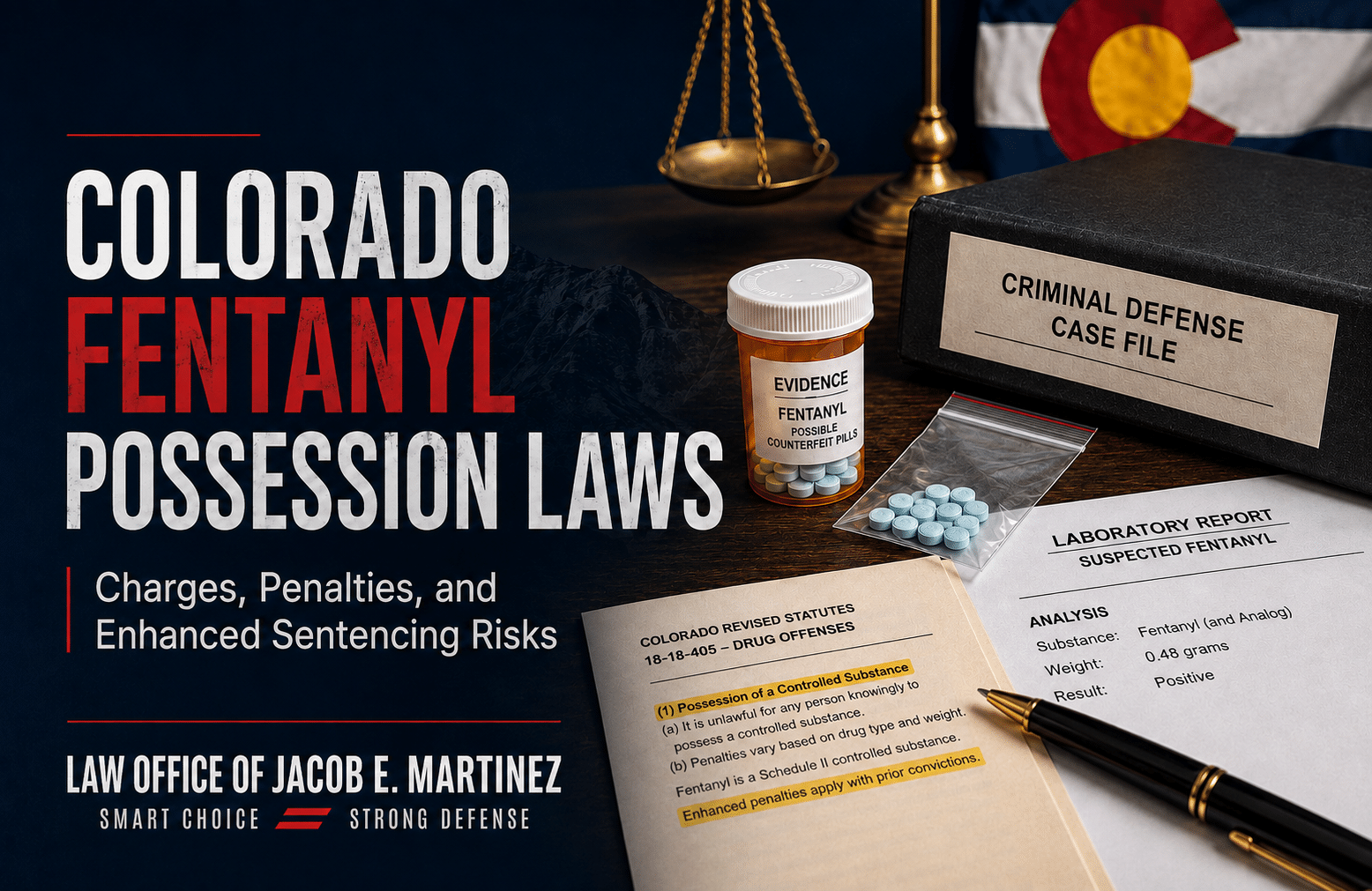
Colorado fentanyl possession charges can become serious felonies at relatively low weight thresholds. The law focuses on the weight of the material, compound, mixture, or preparation containing fentanyl rather than only the amount of pure fentanyl inside it. That means a small-looking quantity of powder or counterfeit pills can result in a much more serious charge once the substance is tested and weighed.
Weight is only part of the case. What the accused person knew, whether the state can prove [...]
Colorado COCCA charges are racketeering charges used when prosecutors claim a person participated in an enterprise through a pattern of criminal activity. These cases often grow out of drug, theft, burglary, fraud, identity theft, or financial investigations that are later reframed as organized conduct.
A COCCA count is not automatic just because several people were charged together or because prosecutors believe more than one crime occurred. The state must prove specific structural elements, including an enterprise and a pattern of [...]